Why Company Secretaries Should Act Fast on CCFS-2026 Compliance
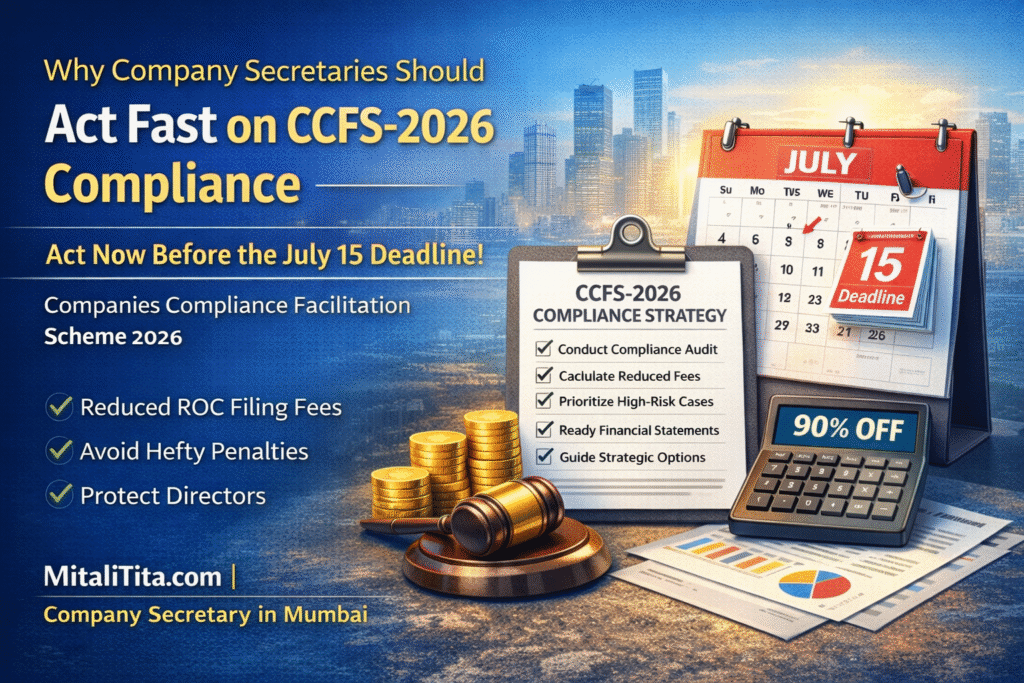
Practical Steps CS Firms Should Take for Clients Before the July 15 Deadline
There are moments in compliance when waiting is expensive.
CCFS-2026 is one of those moments.
The Companies Compliance Facilitation Scheme 2026 has opened a rare window for defaulting companies to clean up pending ROC filings with significantly reduced additional fees. But here’s the catch: the window closes on July 15.
And in compliance work, the last two weeks before a deadline are never smooth.
For professionals, especially every company secretary in Mumbai, this is not just another scheme. It’s a time-sensitive advisory opportunity. Clients are either going to act now with proper guidance — or rush at the last minute and risk errors, rejections, and missed benefits.
Let’s talk about why speed matters and what practical steps CS firms should take immediately.
The Clock Is Ticking — And Portals Get Crowded
Anyone who has handled MCA filings knows this pattern.
Deadlines approach. Everyone waits. Then suddenly, the last 10 days turn chaotic.
-
MCA portal slowdowns
-
DSC issues
-
Director KYC lapses
-
Financial statements not ready
-
Confusion about eligible forms
-
Payment calculation errors
By the time clients react, it’s often too late to fix documentation gaps properly.
That’s why every proactive CS in Mumbai should treat CCFS-2026 as a structured compliance drive — not a last-minute filing rush.
Step 1: Conduct an Immediate Compliance Audit for Clients
Before filing anything, firms must understand the complete exposure.
Start with:
-
Identifying all pending ROC forms (AOC-4, MGT-7, ADT-1, etc.)
-
Checking number of years in default
-
Reviewing director KYC status
-
Verifying DIN activation
-
Assessing adjudication notices, if any
Many companies assume they have “just one pending form.” In reality, defaults often stretch across multiple financial years.
A structured compliance audit allows the company secretary in Mumbai to present a clear roadmap to the client instead of vague advice.
Step 2: Calculate Financial Impact Under CCFS-2026
Clients respond faster when they see numbers.
Calculate:
-
Total accumulated additional fees under normal structure
-
Reduced payable amount under CCFS-2026
-
Actual savings
When promoters see a 70–90% reduction in additional fees, urgency becomes real.
This is where a professional CS in Mumbai adds value — by translating legal notifications into practical financial decisions.
Step 3: Prioritize High-Risk Cases First
Not all clients carry the same risk.
Firms should prioritise:
-
Companies facing adjudication notices
-
Directors at risk of disqualification
-
Businesses planning fundraising
-
Companies planning voluntary strike-off
-
Entities with multiple years of non-filing
Clearing compliance for high-risk clients first ensures protection before the scheme closes.
Waiting could mean exposure to penalties once normal enforcement resumes.
Step 4: Ensure Financial Statements Are Ready
This is often the biggest bottleneck.
Companies that haven’t filed for years may not have:
-
Updated financial statements
-
Board approvals
-
Signed audit reports
-
Proper books reconciliation
Filing without accurate financial preparation leads to rejection or future scrutiny.
A responsible company secretary in mumbai must coordinate with accountants, auditors, and directors to ensure documentation is complete before uploading forms.
Speed without accuracy creates bigger problems.
Step 5: Review Strategic Options — Not Just Filing
Some companies shouldn’t simply file and continue.
They may need to evaluate:
-
Dormant company status
-
Voluntary strike-off
-
Restructuring
-
Director resignation planning
CCFS-2026 provides a compliance reset. That reset should align with long-term business goals.
For example, an inactive company that doesn’t plan to operate again may benefit more from strike-off rather than continuing compliance costs annually.
A strategic advisory approach differentiates a good CS in Mumbai from a transactional filing agent.
Step 6: Create a Filing Calendar Before July 15
Don’t leave everything for the final week.
Break it into phases:
Week 1–2: Compliance audit and documentation collection
Week 3–4: Financial statement preparation and review
Week 5–6: Filing high-risk entities
Final 2 weeks: Balance filings and corrections
When firms follow a structured plan, they avoid portal overload and internal pressure.
Professional discipline is what protects both clients and practitioners.
Step 7: Educate Clients on Post-Scheme Consequences
Many promoters believe that if they miss this scheme, “another one will come.”
That assumption is risky.
After July 15:
-
Reduced additional fees will no longer apply
-
Regular penalty structure resumes
-
Adjudication actions may intensify
-
Director liabilities remain
Explaining consequences clearly creates urgency without fear-based selling.
A knowledgeable company secretary in Mumbai builds trust by presenting reality, not pressure.
Step 8: Build Long-Term Compliance Systems
Clearing pending filings solves yesterday’s problem.
Preventing recurrence solves tomorrow’s.
After regularisation, firms should help clients:
-
Set up annual compliance calendars
-
Schedule reminder systems
-
Conduct quarterly governance reviews
-
Maintain proper board documentation
-
Track statutory due dates digitally
Clients appreciate structured systems. And firms build recurring advisory relationships instead of one-time correction assignments.
Why Mumbai-Based CS Firms Must Act Faster
Mumbai has one of the highest concentrations of private companies, LLPs, startups, and holding entities.
Many of these were incorporated during high-growth years but slipped on compliance during downturns or management changes.
This makes CCFS-2026 particularly relevant for every CS in Mumbai serving corporate clients.
The opportunity is twofold:
-
Help clients reduce financial burden.
-
Strengthen long-term advisory relationships.
A proactive compliance drive can position a company secretary in mumbai as a strategic governance partner rather than just a filing consultant.
The Bigger Picture: Reputation and Responsibility
Compliance is not only about forms and fees.
It is about:
-
Corporate credibility
-
Director protection
-
Investor confidence
-
Regulatory standing
When filings remain pending for years, companies appear negligent.
When they use a scheme like CCFS-2026 wisely, they signal responsibility.
Company Secretaries play a central role in shaping that perception.
Final Thoughts: Speed with Structure Wins
CCFS-2026 is not just a deadline.
It’s a short window to clean records, reduce financial burden, and reset governance discipline.
But this window will not stay open.
The firms that start early will:
-
Avoid portal congestion
-
Prevent documentation errors
-
Protect directors
-
Strengthen client trust
-
Deliver measurable savings
The firms that wait may end up firefighting.
For every company secretary in Mumbai, this is the time to reach out to clients, conduct compliance audits, and build a structured action plan before July 15.