26 August 2026
11 min read
Startup India Recognition:
Eligibility, Process, Benefits
and Common Mistakes
DPIIT recognition costs nothing and opens doors on government tenders, patent fees and seed
funding — but it does not deliver the tax holiday founders expect. Here is what it actually
does, who qualifies, how to apply, and the six mistakes that get applications rejected.
Startup India Recognition
DPIIT Recognition
Section 80-IAC
Inter-Ministerial Board
Startup Tax Exemption
Certificate of Recognition
📌 Quick Answer
Startup India recognition is a Certificate of Recognition issued by the
Department for Promotion of Industry and Internal Trade, formally classifying your business as
a startup under Government of India policy. It costs nothing, the application is entirely online
on the Startup India portal, and a
clean submission is usually approved within a few working days. The critical misconception:
recognition does not deliver a tax holiday. It only makes the entity eligible to
apply for Section 80-IAC through a second, far stricter Inter-Ministerial Board process. Of the
more than 1.9 lakh entities holding DPIIT recognition, only around
3,700 have secured the tax exemption certificate that follows it.
Startup India recognition is a certificate issued by the Department for Promotion of Industry
and Internal Trade that formally classifies your business as a startup under Government of India
policy, unlocking tax, compliance, funding and procurement benefits unavailable to an ordinary
company. It costs nothing, and a clean submission is usually approved within a few working days.
It is also one of the most misunderstood registrations in Indian corporate practice.
If you run a private limited company or LLP under ten years old, recognition costs you nothing
beyond a properly drafted application, and it opens doors on government tenders, patent fees and
seed funding. Getting it right the first time matters — a weak application is rejected, and a
fresh submission restarts the review. Our Startup India registration service
handles the drafting and filing end to end.
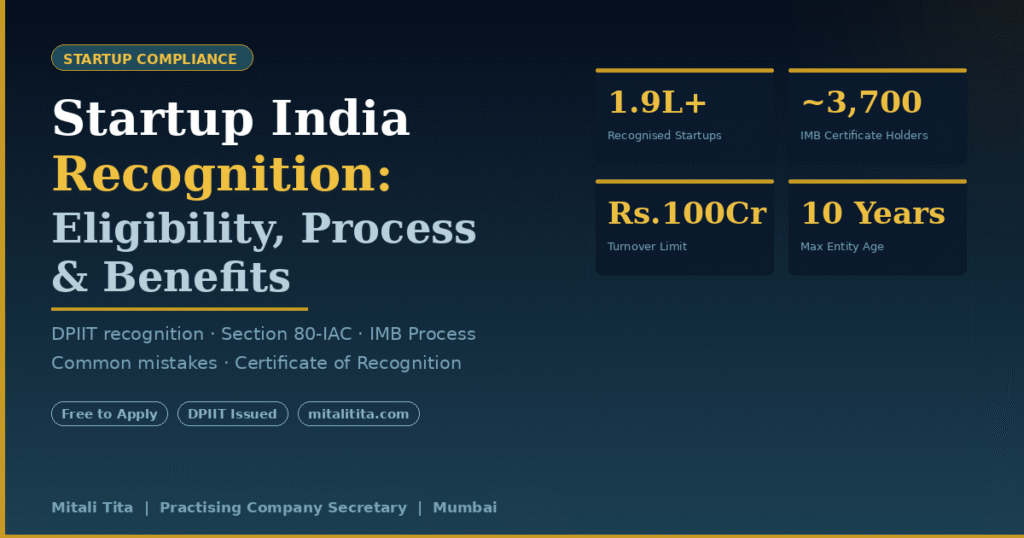
1.9L+
Entities holding DPIIT recognition as of 2026
~3,700
Startups that actually hold the Section 80-IAC tax certificate
₹100 Cr
Turnover ceiling — must not be exceeded in any year since incorporation
10 Yrs
Maximum age from date of incorporation — runs regardless of when you apply
What Is Startup India Recognition and Who Grants It?
Startup India recognition is granted by the Department for Promotion of Industry and
Internal Trade, which sits under the Ministry of Commerce and Industry. The Startup
India initiative was launched on 16 January 2016, and the definition of an eligible startup
now in force comes from DPIIT notification G.S.R. 108(E) dated 19 February 2019.
The output of a successful application is a Certificate of Recognition carrying a
unique DPIIT recognition number, and that number is what every downstream scheme,
tender portal and tax authority asks for.
The short answer to what Startup India recognition is: it is a policy status rather than a
licence to operate. It does not replace incorporation, GST registration, professional tax
registration or any sectoral approval your business needs. What it does is place your entity
inside a defined category that the Government of India has attached specific concessions to,
which is why the Certificate of Recognition is best treated as a key rather than a destination.
📌 Key distinction: Recognition ≠ Tax Exemption. The certificate only opens
the door to applying for the Section 80-IAC deduction — it does not grant it. The Inter-Ministerial
Board runs a separate, stricter process for that.
What Are the Eligibility Criteria for Startup India Recognition?
Four tests decide Startup India eligibility, and all four must be satisfied at the same
time. A fifth condition operates as a disqualifier that removes eligibility outright.
🏢
Eligible Entity Type
Private limited company (Companies Act 2013), LLP (LLP Act 2008), or registered partnership firm (Indian Partnership Act 1932).
📅
Within 10 Years
Must be within ten years of date of incorporation or registration. The clock runs from the certificate date, not from when operations began.
📊
Turnover ≤ ₹100 Crore
Must not have exceeded Rs. 100 crore in any financial year since incorporation — not just the current one. This test looks backwards.
💡
Innovation or Scalability
Working towards innovation, development or improvement of products/processes/services, or a scalable business model with employment or wealth creation potential.
🚫
Disqualifier: Split Business
An entity formed by splitting up or reconstructing an existing business is not eligible. This catches founders who move a profitable division into a new shell.
🚫
Sole Proprietorships Excluded
Proprietors fall outside the definition entirely and must incorporate an eligible vehicle first — which restarts the ten-year clock.
⚠️ Both clocks are absolute. The turnover test looks backwards across every
financial year since incorporation — an entity that touched Rs. 100 crore in an earlier year
and has since fallen below it does not become eligible again. The ten-year age test runs from
the date on the incorporation certificate. Recognition is worth obtaining early rather than
when a specific benefit is needed — if you are still choosing a structure, see our guide on how
to start your business.
How Do You Apply for Startup India Recognition Step by Step?
The application is filed online and requires no physical submission, no notarised affidavit and
no government fee. The effort is concentrated almost entirely in one step — the innovation
narrative — rather than spread evenly across all six.
1
Confirm the entity type and complete incorporation
Recognition cannot be applied for before the entity legally exists — incorporation and the Certificate of Incorporation come first. Choose the structure with the Section 80-IAC tax holiday in mind: a registered partnership firm can obtain DPIIT recognition but is not eligible for the deduction that follows.
2
Create an account on the Startup India portal
Registration on the Startup India portal is free and uses a mobile number and email for OTP verification. Use a founder-controlled email address, not a consultant’s — portal access is needed for every future application and renewal.
3
Complete the recognition application with entity details
Enter entity name, incorporation number, PAN, registered address, and details of every director or designated partner exactly as they appear in statutory records. Any mismatch between the portal entry and the Certificate of Incorporation is a common ground for the application being sent back.
4
Draft the innovation and scalability narrative
This is where applications succeed or fail. The form asks what problem the startup solves, how the solution works, and what makes it innovative or scalable. Generic phrasing about disruption and technology carries no weight. Describe the specific problem, the specific mechanism, and the evidence of traction or intellectual property that supports the claim.
5
Upload the supporting documents
The Certificate of Incorporation is mandatory. Supporting proof strengthens the file considerably: a pitch deck, patent or trademark filing details, product screenshots, a website, awards, incubator association, or evidence of funding received. Weak applications are usually the ones submitted with the incorporation certificate alone.
6
Submit, track and respond to queries promptly
Submission generates an acknowledgement and the application moves into review. A complete file is typically approved within a few working days, and the Certificate of Recognition is issued digitally with a DPIIT number. If a clarification is raised, respond within the stated window — an unanswered query results in rejection and a fresh application restarts the review.
✅ No government fee at any stage. The application, the Certificate of Recognition,
and the Inter-Ministerial Board application for tax exemption are all free. Any intermediary
charging a “government fee” is misrepresenting the process.
What Are the Real Benefits of DPIIT Recognition?
DPIIT recognition benefits fall into five practical groups. What a DPIIT recognised startup
actually gains varies enormously with the stage of the business.
🔬
Intellectual Property Support
80% rebate on patent filing fees, 50% rebate on trademark filing fees, fast-track patent examination, and facilitator fees borne by the government. For a startup building a brand, the trademark registration rebate alone often covers the cost of professional help with the recognition application.
📋
Compliance Relief
Self-certify compliance with 9 labour laws and 3 environmental laws for 5 years from incorporation. Generally not subject to labour inspection during that period unless a credible complaint is filed.
🏛️
Public Procurement Access
Exempted from prior turnover and prior experience requirements in government tenders, and from earnest money deposit conditions — removing the circular problem of needing government contracts to qualify for government contracts.
💰
Funding Schemes
Startup India Seed Fund Scheme: up to Rs. 20 lakh grant for proof of concept or prototype, up to Rs. 50 lakh for market entry (through selected incubators). Credit Guarantee Scheme for Startups supports collateral-free debt.
🚪
Fast-Track Exit
A recognised startup can be wound up through a fast-track process within 90 days of application — significantly faster than the standard winding-up process under the Companies Act.
📉
Tax Holiday Eligibility
Makes the entity eligible to apply for the Section 80-IAC deduction — 100% of profits for any 3 consecutive years out of the first 10. Requires a separate Inter-Ministerial Board application. See below.
Fund of Funds clarification: The Fund of Funds for Startups (Rs. 10,000 crore
corpus via SIDBI) does not invest in startups directly — it invests in SEBI-registered
alternative investment funds, which then invest in startups. This is commonly misunderstood
as direct government investment.
How Did Startup India Evolve From the Licence Raj to DPIIT Recognition?
Pre-1991
Industrial licences required for most manufacturing. MRTP Act restricted expansion by larger businesses. FERA capped foreign shareholding at 40%. Entrepreneurship was an exercise in obtaining permissions.
1991–2005
Industrial licensing abolished for most sectors. MRTP Act replaced by Competition Act 2002. FERA replaced by FEMA 1999. Venture capital and private equity entered India. No statutory definition of a startup existed.
2013–2016
Companies Act 2013 and LLP Act 2008 supplied the corporate vehicles recognition attaches to. Startup India initiative launched 16 January 2016.
2017–2019
GST (July 2017) replaced fragmented state-wise indirect tax with a single national system. Section 80-IAC introduced from 1 April 2017. DPIIT notification G.S.R. 108(E) refined the startup definition (February 2019).
2024–2026
Finance (No. 2) Act 2024 abolished angel tax under Section 56(2)(viib) from AY 2025-26. Finance Act 2025 extended the Section 80-IAC window to entities incorporated before 1 April 2030. Income-tax Act 2025 in force from 1 April 2026, renumbering provisions without altering the startup deduction’s substance.
⚠️ Angel tax is gone — update your reasoning. Angel tax under Section 56(2)(viib)
was abolished by the Finance (No. 2) Act 2024 from assessment year 2025-26. Any guide still
listing angel tax exemption as a recognition benefit is working from outdated material. Assessments
for earlier years remain open under the old provisions.
What Are the Most Common Mistakes in Startup India Recognition Applications?
-
1
Treating the innovation write-up as a formality. Applications that describe the business as a “technology-driven disruptive platform” without explaining what it actually does are the ones that come back for clarification or get rejected. The reviewer is assessing a specific claim — the description needs a specific problem, a specific solution, and specific evidence.
-
2
Assuming recognition itself delivers the startup tax exemption. It does not — and the gap between 1.9 lakh recognised startups and ~3,700 IMB certificate holders tells the story. Recognition only makes you eligible to apply for Section 80-IAC.
-
3
Choosing the wrong entity type. A registered partnership firm qualifies for DPIIT recognition but is excluded from Section 80-IAC, which is limited to private limited companies and LLPs. A founder who intends to claim the deduction should not be operating as a partnership firm.
-
4
Relying on advice written before 2024. Any guide still listing angel tax exemption as a benefit of recognition is describing a provision that no longer exists for new fund raises. FEMA pricing rules and RBI compliance obligations are entirely separate and continue regardless.
-
5
The Section 115BAA tax election trap. A company that opts into the concessional corporate tax regime under Section 115BAA forfeits most Chapter VI-A deductions, including Section 80-IAC. The two cannot be combined — this choice should be modelled before it is made, ideally within the wider annual compliance calendar.
-
6
Simply waiting. Both the ten-year clock and the turnover ceiling run from incorporation regardless of when you apply. Delay only shortens the window in which recognition is worth anything — and the IMB application process takes up to 120 days of its own.
Does Startup India Recognition Automatically Give You Tax Exemption?
No. The Certificate of Recognition makes an entity eligible to apply for the startup
tax exemption under Section 80-IAC; a separate application to the
Inter-Ministerial Board decides whether it is granted. The board assesses innovation,
scalability, employment potential and financial health, and complete applications are reviewed
within 120 days. Only after the board issues a Certificate of Eligibility can the startup
actually claim the deduction in its return.
| Feature | Section 80-IAC Details |
|---|---|
| Deduction quantum | 100% of profits from the eligible business |
| Years claimable | Any 3 consecutive years chosen out of the first 10 years from incorporation — claim the most profitable years, not necessarily the earliest |
| Eligible entities | Private limited companies and LLPs only — registered partnership firms excluded |
| Incorporation window | Before 1 April 2030 (extended by Finance Act 2025) |
| Turnover ceiling | Tested in each year the deduction is claimed |
| MAT applicability | Minimum Alternate Tax can still apply |
| Incompatible elections | Section 115BAA regime forfeits 80-IAC — cannot be combined |
| Documentation | Accountant’s report filed with the income-tax return in the year of claim |
Startups taking foreign investment have a parallel set of obligations that recognition does not
touch. Share allotments to non-residents require reporting to the Reserve Bank of India within
the prescribed timeline, and pricing must meet fair market value rules — dealt with under
RBI and FEMA compliance. Recognition
offers no relief from those requirements.
Why Founders Choose Mitali Tita for Startup India Recognition
✍️
Innovation Narrative Drafted
We draft the business description that reviewers actually approve — specific problem, specific mechanism, specific evidence — not generic disruption language.
🏗️
Structure Advice First
We resolve the private limited vs LLP vs partnership question before filing — because entity choice determines both recognition eligibility and 80-IAC access.
📑
End-to-End Filing
From portal account creation through document upload, query response and Certificate of Recognition delivery — handled entirely by our team.
🧾
IMB Application Prepared
We prepare the Inter-Ministerial Board application for Section 80-IAC — the step that 98% of recognised startups never reach.
🌐
FEMA & RBI Compliance
Foreign investment reporting, FEMA pricing compliance, and RBI filings run alongside recognition — handled under a single engagement where needed.
📆
Full Compliance Calendar
Recognition sits inside your wider mandatory compliance calendar — we manage the full picture, not just the recognition filing.
MT
Mitali Tita
Practising Company Secretary · Mumbai
Mitali Tita is a qualified, practising Company Secretary based in Mumbai advising startups,
SMEs, NBFCs and foreign investors on company incorporation, ROC compliance, SEBI and RBI
regulation, and startup recognition and funding compliance. Office: Suite No.102, L1, Ashok
Premises, Nicholas Road, Andheri (East), Mumbai 400069 · +91 98190 00640 ·
+91 98218 32683 · info@mitalitita.com
Startup India Recognition — Your Questions Answered
Direct answers to what founders and directors ask most — what recognition is, how long it takes,
whether there’s a fee, whether sole proprietors qualify, and whether recognition gives automatic
tax exemption.
It is a Certificate of Recognition issued by the Department for Promotion of Industry and
Internal Trade to an entity that meets the startup definition notified by the Government of
India. It applies to a private limited company, a limited liability partnership or a
registered partnership firm that is under ten years old, has never crossed Rs. 100 crore
turnover in any financial year, and is working on innovation or a scalable business model.
The certificate is issued free of cost through the Startup India portal and carries a unique
DPIIT recognition number used for every downstream benefit.
A complete application is generally processed within a few working days, and many founders
receive the Certificate of Recognition within two to three working days of submission.
Delays almost always come from the applicant side rather than the department. Incomplete
uploads, a business description that does not explain the innovation, or a mismatch between
the incorporation certificate and the details entered on the portal will result in the
application being returned for clarification. Applications that are rejected can be
re-submitted, but the review restarts from the beginning.
No. Startup India registration carries no government fee at any stage. The
application on the Startup India portal is free, the Certificate of Recognition is free, and
the separate Inter-Ministerial Board application for tax exemption is also free. Founders are
sometimes charged a supposed government fee by intermediaries, which does not exist.
Professional fees for drafting the application and preparing supporting documentation are
legitimate and separate, but nothing is payable to the Department for Promotion of Industry
and Internal Trade itself.
No. A sole proprietorship falls outside the notified startup definition and
cannot obtain DPIIT recognition regardless of how innovative the business is. Only a private
limited company incorporated under the Companies Act 2013, a limited liability partnership
under the LLP Act 2008, or a partnership firm registered under the Indian Partnership Act
1932 qualifies. Proprietors who want recognition must first convert or incorporate a fresh
eligible entity, and the ten-year age clock then runs from the incorporation date of that
new entity.
No, and this is the single most common misunderstanding among founders. The
Certificate of Recognition only makes an entity eligible to apply for the Section 80-IAC tax
holiday; it does not grant the exemption. A separate application goes to the
Inter-Ministerial Board, which assesses innovation, scalability, employment potential and
financial health before issuing a Certificate of Eligibility. Fewer than two per cent of
recognised startups currently hold that certificate, so the DPIIT recognition benefits and
the startup tax exemption should be planned as two distinct exercises.
You May Also Find Useful
Startup Compliance
Startup India Registration — End-to-End Filing Service
View Service →
Company Formation
Start Your Business — Choosing the Right Structure
Read Guide →
Trademark
Trademark Registration — Procedure, Rebates and Protection
Read Guide →
Annual Compliance
Mandatory Compliances — Every Filing That Falls Due
Read Guide →
Foreign Investment
RBI and FEMA Compliance for Startups with Foreign Investment
Read Guide →
Annual Filing
MGT-7A vs MGT-7 — Which Annual Return Form Applies?
Need Professional Help with Startup India Recognition?
We handle the whole process end to end — from choosing the right entity structure through to
the Inter-Ministerial Board application that turns DPIIT recognition into an actual startup tax
exemption. A rejected file costs time you cannot recover from the ten-year clock.
First consultation is free.
This article is for general information and is not legal advice. The Companies Act 2013, LLP Act
2008, Income-tax Act 2025, and DPIIT notifications are subject to amendment without notice.
Please consult a qualified professional for advice specific to your entity’s circumstances and
confirm current thresholds, forms and fee structures on official government portals before
acting. Mitali Tita | Practising Company Secretary | Suite No.102, L1, Ashok Premises,
Nicholas Road, Andheri (East), Mumbai 400069 | info@mitalitita.com | +91 98190 00640.