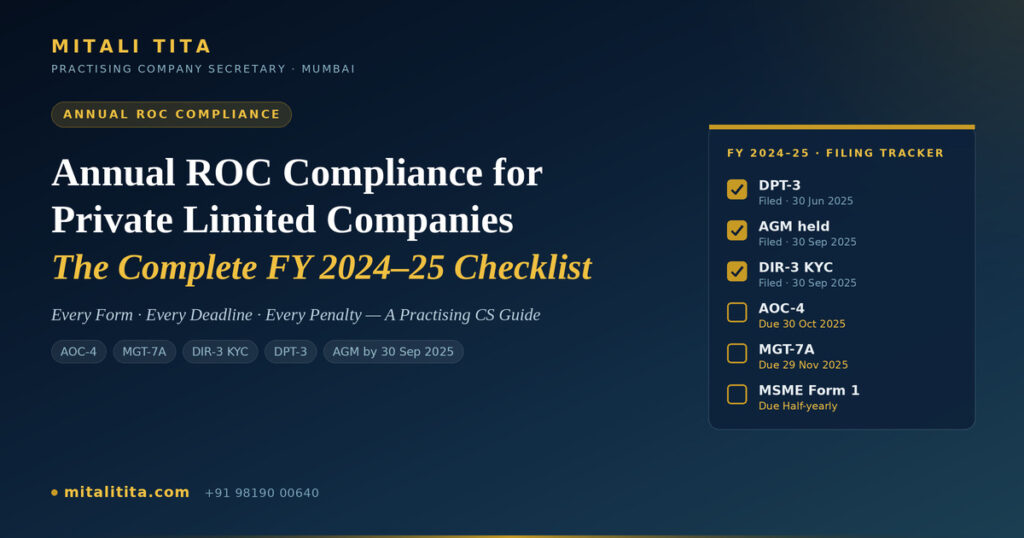
FY 2024–25 Complete Checklist
Annual ROC Compliance for
Private Limited Companies —
FY 2024–25 Complete Checklist
A Practising CS guide to every form, every deadline, and every penalty — 4 board meetings · AGM by 30 September 2025 · DPT-3 by 30 June 2025 · DIR-3 KYC by 30 September 2025 · AOC-4 by 30 October 2025 · MGT-7A by 29 November 2025 · ₹100/day late fees with no upper cap.
FY 2024–25 AOC-4 MGT-7A DIR-3 KYC DPT-3 AGM by 30 Sep 2025For FY 2024–25 (1 April 2024 to 31 March 2025), every Private Limited Company must: hold a minimum of 4 board meetings (2 for small companies and OPCs) with proper notices, quorum, and minutes; file DPT-3 by 30 June 2025; hold its AGM by 30 September 2025; file DIR-3 KYC for every director by 30 September 2025; file AOC-4 (audited financial statements) within 30 days of the AGM — by 30 October 2025; and file MGT-7A / MGT-7 (annual return) within 60 days of the AGM — by 29 November 2025 — plus MSME Form 1 half-yearly returns, ADT-1, MGT-14, MBP-1, and statutory register updates where applicable. Missing a deadline attracts ₹100 per day per form with no upper cap, DIN deactivation, director disqualification under Section 164(2) after 3 consecutive years of default, and — in extreme cases — strike-off of the company under Section 248.
Every Private Limited Company registered under the Companies Act, 2013 is required to complete a set of annual compliance filings with the Registrar of Companies (ROC) at the Ministry of Corporate Affairs (MCA). These are not optional — they are mandatory legal obligations, and missing even a single deadline can result in penalties of ₹100 per day per form, director disqualification, or in extreme cases, the striking off of the company itself. For FY 2024–25 (April 1, 2024 to March 31, 2025), the annual compliance cycle includes board meetings, an Annual General Meeting (AGM), financial statement filing in AOC-4, annual return in MGT-7A, director KYC in DIR-3, and several other event-based and periodic returns.
Mitali Tita is a practising Company Secretary (CS) based in Andheri East, Mumbai. With 10+ years of CS experience and 500+ companies served, her practice specialises exclusively in company law compliance, ROC filings, MCA advisory, secretarial audit, and corporate governance. Annual ROC compliance is the most time-sensitive and consequence-laden area of company law — and getting it right, on time, every year, is precisely what a practising CS exists to do. This complete checklist for FY 2024–25 is designed to be the most detailed and actionable guide available for directors, founders, and company secretaries of Private Limited Companies in India.
If your company’s annual filings are overdue or you are uncertain about your compliance status, our Annual Filings of Company service covers end-to-end compliance from AGM to ROC filing, board minutes to statutory registers.
⚠️ Coverage Check: This checklist covers FY 2024–25 (April 1, 2024 to March 31, 2025). All deadlines referenced are for companies with a financial year ending March 31, 2025, and AGM held by September 30, 2025. 4 Minimum board meetings per year (2 for small companies & OPCs) ₹100 Per day per form late fee — with no upper cap for most forms 30 Sep 2025 — deadline for both the AGM and DIR-3 KYC for every director 3 Yrs Of consecutive non-filing triggers director disqualification u/s 164(2)Why Annual ROC Compliance Is a Company Secretary’s Domain — Not Just an Accountant’s
A common misconception among small company directors is that their CA (Chartered Accountant) handles all annual compliance. The CA prepares and audits financial statements — but the majority of annual ROC compliance falls squarely within the domain of a practising Company Secretary. Here is the precise division:
| Compliance Task | Who Does It | Form / Document | Notes |
|---|---|---|---|
| Statutory Audit | CA | Audit Report | CA certifies financials |
| AOC-4 Filing | CS + CA | AOC-4 | CS files; audited FS attached |
| MGT-7A Annual Return | CS | MGT-7A | CS certifies for small companies |
| AGM Notice & Conduct | CS | Board Resolution | CS drafts, sends notice |
| Board Meeting Minutes | CS | Minutes Book | CS prepares and certifies |
| DIR-3 KYC | CS | DIR-3 KYC | CS files for all directors |
| DPT-3 | CS | DPT-3 | CS files deposits return |
| Statutory Registers | CS | MGT-1 to MGT-3 | CS maintains and certifies |
| Secretarial Audit MR-3 | PCS only | MR-3 | Only a Practising CS can certify |
| MSME Half-Yearly Return | CS | MSME Form 1 | CS files if applicable |
As the table above shows, while the CA is responsible for auditing and certifying financial statements, the lion’s share of annual ROC compliance — the board meetings, AGM, annual return, director KYC, registers, and most MCA filings — is the domain of the Company Secretary. For companies without a whole-time CS (i.e., most Private Limited Companies below ₹10 crore paid-up capital), a Practising Company Secretary like Mitali Tita provides these services on a retainer or annual engagement basis.
How Has Annual ROC Compliance Evolved for Private Limited Companies in India?
The framework for corporate compliance in India has its roots in the Companies Act, 1956, which itself was modelled significantly on UK company law. Under the 1956 Act, private companies enjoyed substantial exemptions from compliance — a deliberate policy choice to encourage private business formation. Annual filings were required, but the penalty regime was lenient, and enforcement by Registrars of Companies was inconsistent. Directors routinely missed filing deadlines with minimal consequence.
The Companies Act, 2013, which replaced the 1956 Act in phases from 2014 onwards, fundamentally changed this. The 2013 Act introduced a dramatically stricter penalty regime — ₹100 per day per form (with no upper cap for most forms), director disqualification under Section 164(2) for companies that miss AOC-4 and MGT-7 filings for three consecutive years, and mandatory company strike-off under Section 248 for companies that fail to file returns for two or more consecutive years. The MCA’s V2 portal, launched in 2006 and upgraded to V3 in 2022, made electronic filing mandatory, created a real-time compliance database, and enabled the Registrar to track non-filing with far greater efficiency than was possible under the paper-based 1956 Act system.
The introduction of the Companies (Amendment) Act, 2017 and further amendments in 2019 and 2020 brought additional changes — notably the simplification of the MGT-7 form into MGT-7A for small companies and OPCs, and the introduction of various one-time amnesty schemes (CODS, CFSS) to help defaulting companies regularise their filings. The MCA’s ACTIVE (Active Company Tagging Identities and Verification) e-form, introduced in 2019, added another layer of compliance by requiring companies to verify their registered office address. Today, the annual compliance framework for a Private Limited Company is more structured, more enforced, and more consequential than at any previous point in Indian corporate history.
Mitali Tita’s Mandatory Compliances services cover the complete annual compliance cycle — from the first board meeting of the year to the final ROC filing after the AGM.
FY 2024–25 Key Deadlines at a Glance
Before diving into the section-by-section checklist, here is the master deadline calendar for FY 2024–25 — assuming a March 31, 2025 year-end and AGM on or before September 30, 2025:
| Compliance | Form | Statutory Timeline | FY 2024–25 Due Date |
|---|---|---|---|
| MBP-1 — Director interest disclosure | MBP-1 | First board meeting of each financial year | April 2024 board meeting |
| MSME half-yearly return (Apr–Sep 2024) | MSME Form 1 | For dues to MSME suppliers beyond 45 days | 31 October 2024 |
| MSME half-yearly return (Oct 2024–Mar 2025) | MSME Form 1 | For dues to MSME suppliers beyond 45 days | 30 April 2025 |
| Return of deposits / exempted amounts | DPT-3 | Annually by June 30 for the preceding FY | 30 June 2025 |
| FLA Return (FDI companies — RBI/FEMA) | FLA | Annually by July 15, via AD banks | 15 July 2025 |
| Annual General Meeting | — | Within 6 months of FY end (Section 96) | 30 September 2025 |
| Director KYC — every DIN holder | DIR-3 KYC | Annually by September 30 | 30 September 2025 |
| Auditor appointment intimation | ADT-1 | Within 15 days of appointment at AGM | By 15 Oct 2025 (if AGM on 30 Sep) |
| Financial statements filing | AOC-4 | Within 30 days of AGM | 30 October 2025 |
| Annual return | MGT-7A / MGT-7 | Within 60 days of AGM | 29 November 2025 |
| Board resolutions u/s 179 | MGT-14 | Within 30 days of passing the resolution | Event-based (throughout the year) |
The Complete FY 2024–25 Annual ROC Compliance Checklist for Private Limited Companies
📌 Note: FY 2024–25 = April 1, 2024 to March 31, 2025. All deadlines below assume a March 31 year-end and AGM on or before September 30, 2025.Section 1: Board Meeting Compliance Throughout FY 2024–25
The Companies Act, 2013 under Section 173 requires every company to hold a minimum of 4 board meetings per year, with a maximum gap of 120 days between any two consecutive meetings. For Small Companies and OPCs (One Person Companies), Section 173(5) provides a relaxation — only 2 board meetings per year are required (one in each half of the calendar year), with a gap of not less than 90 days between the two meetings. Most Private Limited Companies (other than small companies and OPCs) must hold 4 board meetings.
- Q1 Board Meeting held between April 1 and June 30, 2024
- Q2 Board Meeting held between July 1 and September 30, 2024
- Q3 Board Meeting held between October 1 and December 31, 2024
- Q4 Board Meeting held between January 1 and March 31, 2025
- Gap between any two consecutive meetings does not exceed 120 days
- Meeting notices issued with 7 days’ advance notice (or shorter with consent of directors)
- Quorum met at every board meeting (one-third of total directors or 2, whichever is higher)
- Board meeting minutes prepared within 30 days of each meeting (Section 118)
- Minutes signed by the Chairman and entered in the Minutes Book
- Resolutions passed by circulation (if any) properly documented with consent of majority directors
Section 2: Annual General Meeting (AGM) — FY 2024–25
Every Private Limited Company must hold its Annual General Meeting (AGM) within 6 months from the end of the financial year — i.e., by September 30, 2025 for FY 2024–25, under Section 96 of the Companies Act, 2013. Newly incorporated companies must hold their first AGM within 9 months of the end of the first financial year, or 18 months from the date of incorporation, whichever is earlier.
- AGM held on or before September 30, 2025
- 21 clear days’ written notice of AGM sent to all members, directors, and auditor
- Notice contains: time, date, place, and agenda of AGM
- Audited financial statements (Balance Sheet, P&L, Cash Flow, Notes) approved at board meeting before AGM
- Board’s Report prepared for FY 2024–25 (Section 134) and approved by board before AGM
- Auditor’s Report annexed to financial statements
- Financial statements laid before members at AGM
- Dividend declared (if any) at AGM — board recommendation confirmed
- AGM minutes prepared within 30 days and entered in the Minutes Book
- If AGM could not be held: application for extension filed with Registrar before September 30, 2025
Non-holding of AGM is an offence under Section 99 — the company and every officer in default is liable to a fine of up to ₹1,00,000, and a further fine of ₹5,000 per day for continuing default. Directors can also be directed to hold the AGM by the Tribunal.
Section 3: AOC-4 — Filing of Financial Statements
AOC-4 is the e-form for filing audited financial statements with the Registrar of Companies. It must be filed within 30 days of the AGM (or within 30 days of the date by which the AGM should have been held, if the AGM is not held). For FY 2024–25 with AGM by September 30, 2025, the AOC-4 deadline is October 30, 2025.
- AOC-4 filed within 30 days of the date of AGM (or within 30 days of the AGM deadline if AGM not held) — by October 30, 2025
- Audited Balance Sheet, P&L, Cash Flow Statement, and Notes to Accounts attached
- Board’s Report (Section 134) and Directors’ Responsibility Statement attached
- Auditor’s Report attached
- Company with XBRL obligation: XBRL-format financial statements attached in AOC-4 XBRL
- Form certified by a Practising CA (for most companies) or CS where required
- Late filing fee: ₹100 per day from the due date — no upper cap
Section 4: MGT-7A — Annual Return
The Annual Return in MGT-7A (for small companies and OPCs) or MGT-7 (for all other companies) must be filed within 60 days of the AGM. For FY 2024–25 with AGM by September 30, 2025, the MGT-7A/MGT-7 deadline is November 29, 2025. The Annual Return contains details of the company’s shareholders, directors, capital structure, indebtedness, and compliance status as on the date of the AGM.
- MGT-7A filed within 60 days of the date of AGM (for Small Companies and OPCs) — by November 29, 2025
- MGT-7 filed within 60 days of the date of AGM (for all other Private Limited Companies)
- Certified by a Practising Company Secretary (PCS) for companies with paid-up capital above ₹10 lakh — or self-certified by a director for exempted small companies
- Shareholder register as on AGM date reflected accurately in MGT-7A/MGT-7
- Director details, DIN, and appointment/cessation dates updated correctly
- Disclosure of principal business activity and holding/subsidiary/associate company details
- Indebtedness details as on the close of FY 2024–25 correctly reported
- Late filing fee: ₹100 per day from the due date — director disqualification risk if 3 consecutive years of default
Mitali Tita provides end-to-end Annual Filings of Company services including MGT-7A/MGT-7 preparation, CS certification, and MCA filing — with no risk of missed deadlines.
Section 5: DIR-3 KYC — Annual Director KYC
Every individual who has been allotted a Director Identification Number (DIN) must file DIR-3 KYC or web-based DIR-3 KYC annually by September 30 of each year to keep their DIN active. For FY 2024–25 compliance purposes, the DIR-3 KYC deadline for all DIN holders is September 30, 2025. A DIN that is not KYC-verified is marked as ‘Deactivated due to non-filing of DIR-3 KYC’ — and the DIN holder must pay a ₹5,000 fee to reactivate it.
- DIR-3 KYC filed for ALL directors holding DIN, by September 30, 2025
- Web DIR-3 KYC (for DIN holders with no change in details) filed online without digital signature
- DIR-3 KYC (full form, for DIN holders with changed mobile/email) filed with DSC and OTP verification
- Mobile number and email ID in DIR-3 KYC are unique to each DIN holder
- PAN details match the records held with MCA
- Address and Aadhaar details are current and accurate
Section 6: DPT-3 — Return of Deposits
DPT-3 is an annual return that every company (other than government companies) must file with the ROC, reporting the details of money received by the company that is not considered a deposit (i.e., loans from directors, shareholders, and related parties — which are exempted from the definition of ‘deposits’ under Rule 2(1)(c) of the Companies (Acceptance of Deposits) Rules, 2014). DPT-3 must be filed annually by June 30 for the preceding financial year. For FY 2024–25, the DPT-3 deadline is June 30, 2025.
- DPT-3 filed by June 30, 2025 for FY 2024–25
- Auditor’s certificate attached to DPT-3 (mandatory)
- All outstanding amounts as on March 31, 2025 reported correctly
- Shareholder loans, director loans, and inter-corporate deposits classified correctly
- Companies with actual deposits: separate DPT-3 return for actual deposits filed
Section 7: Other Important Annual and Ongoing Compliances
Beyond the forms above, there are several additional compliance requirements that apply to most Private Limited Companies:
- Appointment of First Auditor — within 30 days of incorporation (only for newly incorporated companies in FY 2024–25)
- ADT-1 — Auditor appointment form filed within 15 days of appointment at AGM
- Statutory Registers maintained and updated — Register of Members (MGT-1), Register of Directors & KMP, Register of Contracts in which Directors are Interested (MBP-4), Register of Charges (CHG-7)
- Form MGT-14 — filed within 30 days for resolutions passed u/s 179 (board resolutions for borrowing, investment, giving loans/guarantees)
- MBP-1 — Every director discloses interest in other entities at the first board meeting of each financial year (April 2024 board meeting for FY 2024–25)
- Half-Yearly MSME Return (MSME Form 1) — for companies who have outstanding dues to MSME suppliers beyond 45 days. Due: October 31, 2024 (April–September) and April 30, 2025 (October–March)
- Annual DIN-DPIN KYC for Designated Partners of LLPs — DIR-3 KYC by September 30, 2025
- Share certificates issued within 60 days of allotment (for any fresh allotment in FY 2024–25)
- eStamping of share certificates if physical share certificates issued
- SBO (Significant Beneficial Owner) compliance under Section 90 — BEN-2 filed for any changes in SBO during FY 2024–25
Mitali Tita’s Statutory Registers & Minutes service covers the maintenance, certification, and updating of all statutory registers required under the Companies Act, 2013.
What Are the Penalties for Missing Annual ROC Compliance Deadlines?
The penalty regime under the Companies Act, 2013 is strict and in many cases escalates without an upper cap. Here is a summary of the key penalties:
| Form / Compliance | Late Fee | Consequence of Prolonged Default |
|---|---|---|
| AOC-4 | ₹100/day (no cap) | Strike-off under S.248; Director disqualified under S.164(2) after 3 years |
| MGT-7A / MGT-7 | ₹100/day (no cap) | Strike-off; Director disqualification under S.164(2) after 3 years |
| DIR-3 KYC | ₹5,000 reactivation fee | DIN deactivated — director cannot sign any form until reactivated |
| DPT-3 | ₹5,000 + ₹500/day continuing | Officer in default personally liable |
| ADT-1 | ₹100/day | Auditor appointment not valid until filed |
| MGT-14 | ₹100/day | Resolutions not valid for third parties without filing |
| MSME Form 1 | ₹25,000 company; ₹25,000 per officer | Personal liability of directors and CFO |
| Non-holding of AGM | Up to ₹1,00,000 | Further ₹5,000/day; Tribunal direction to hold AGM |
Step-by-Step Process: How Mitali Tita Manages Annual ROC Compliance for Your Company
1 Compliance Audit at the Start of EngagementMitali Tita reviews your company’s last 3 years of MCA filings to identify any outstanding defaults, missing forms, or pending regularisation that need to be addressed before the current year compliance cycle begins.
2 Compliance Calendar PreparationA customised compliance calendar for FY 2024–25 is prepared for your company, listing every form, every deadline, and every document required, so nothing is missed.
3 Board Meeting Scheduling and Notice PreparationNotices for all required board meetings are drafted and issued with the mandatory 7 days’ advance notice. Agendas are prepared in accordance with Companies Act, 2013 requirements.
4 Minutes PreparationMinutes of every board meeting are drafted within 30 days, reviewed with the Chairman, and entered in the Minutes Book. All resolutions are properly worded in accordance with the Act.
5 AGM PreparationThe notice of AGM, agenda, and required documents (directors’ report, financial statements) are prepared and dispatched to all members with the mandatory 21 clear days’ notice.
6 AOC-4 FilingAfter the auditor certifies the financial statements, AOC-4 is prepared with all required attachments and filed on the MCA portal within the 30-day deadline.
7 MGT-7A / MGT-7 FilingThe annual return is prepared, CS-certified where required, and filed within 60 days of the AGM.
8 DIR-3 KYC and Other ComplianceAll director KYC filings, DPT-3, MSME returns, and other applicable forms are filed within their respective deadlines.
How Does Annual ROC Compliance Differ Across Types of Private Limited Companies?
Small Companies — Relaxed Compliance Framework
Under the Companies Act, 2013 as amended, a Small Company is one whose paid-up share capital does not exceed ₹4 crore and turnover does not exceed ₹40 crore in the preceding financial year. Small Companies enjoy significant compliance relaxations: only 2 board meetings per year (instead of 4), a simpler MGT-7A annual return (with self-certification allowed by a director), and exemption from the requirement to include the cash flow statement in financial statements. However, AOC-4, DIR-3 KYC, DPT-3, and AGM requirements apply equally.
Startups — Additional Compliances to Be Aware Of
DPIIT-recognised startups have some compliance relaxations (self-certification under labour laws, faster IPR processing), but annual ROC compliance under the Companies Act is mandatory without relaxation. Startups that have issued ESOPs, convertible notes, or CCPS must additionally ensure that ESOP Scheme Compliance and Issuance of CCPS post-allotment compliance is completed within the prescribed timeframes.
Companies with Foreign Investment — FEMA Overlay
Private Limited Companies that have received foreign direct investment (FDI) have an additional layer of annual compliance under FEMA — specifically the Annual FLA Return (Foreign Liabilities and Assets), which must be filed with the RBI through authorised dealer banks by July 15 each year. Our FLA Return Compliance service covers this alongside annual ROC compliance for FDI-receiving companies.
Companies Above ₹50 Crore Paid-Up Capital — Secretarial Audit Required
Public companies with paid-up share capital above ₹50 crore, and companies with turnover above ₹250 crore or outstanding loans above ₹100 crore, are required to obtain a Secretarial Audit Report in Form MR-3 from a Practising Company Secretary. Mitali Tita conducts Secretarial Audit as an authorised PCS — reviewing compliance with the Companies Act, SEBI regulations, FEMA, and all other applicable laws.
Why Companies Across India Choose Mitali Tita for Annual ROC Compliance
🎓 CS Expertise, Not Generalist FilingAnnual ROC compliance is all Mitali Tita does — not a side service bundled with tax filing. Every form is prepared, reviewed, and certified by a qualified, practising CS who understands the Companies Act in depth.
⏰ Zero Deadline MissesA customised compliance calendar is maintained for every client company. Advance reminders, document collection, and filing happen systematically — so clients never face the ₹100/day late fee or the risk of director disqualification.
💻 100% Digital, Pan-India ServiceAll services are delivered digitally — documents shared securely, MCA filings done electronically, and all communication via WhatsApp, email, or video call. Clients across Mumbai, Hyderabad, Delhi, Bangalore, and overseas are served without any need for physical visits.
💰 Transparent, Fixed-Fee EngagementAnnual compliance retainer fees are fixed and disclosed upfront — no surprise invoices, no per-form billing shocks. Clients know exactly what they are paying for the full year.
🤝 Integrated Corporate AdvisoryBeyond annual filings, Mitali Tita provides company law advisory on share transfers, director changes, capital increases, and restructuring — a single trusted CS for all corporate governance matters. Explore our full range of Change Services for any mid-year corporate changes your company may need.
MT Mitali Tita Practising Company Secretary · MumbaiMitali Tita is a Practising Company Secretary in Mumbai with 10+ years of CS experience and 500+ companies served. Her practice specialises exclusively in annual ROC compliance — AOC-4 and MGT-7A/MGT-7 filings, AGM and board meeting support, DIR-3 KYC, DPT-3, statutory registers and minutes, secretarial audit, and regularisation of overdue filings — delivered 100% digitally, pan-India. Office: Suit No.102, L1, Ashok Premises, Nicholas Road, Andheri East, Mumbai 400069 · +91 98190 00640 / +91 98190 00445.
Annual ROC Compliance for Private Limited Companies — Your Questions Answered
Direct answers to the most common questions on FY 2024–25 — the AOC-4 and MGT-7A due dates, whether a CS is mandatory, DIR-3 KYC deactivation, DPT-3 applicability, and how to regularise overdue filings.
For FY 2024–25, assuming the AGM is held on September 30, 2025 (the last permissible date), the AOC-4 (financial statements) is due by October 30, 2025 (30 days from AGM), and the MGT-7A / MGT-7 (annual return) is due by November 29, 2025 (60 days from AGM). If the AGM is held earlier, the deadlines advance accordingly. Late filing attracts ₹100 per day per form from the due date. Under the Companies Act, 2013, a whole-time Company Secretary is mandatory for companies with paid-up share capital of ₹10 crore or more. For companies below this threshold, a whole-time CS is not mandatory — but the annual return (MGT-7) for companies with paid-up capital above ₹10 lakh must be certified by a Practising Company Secretary. For filing AOC-4, director KYC, and other MCA forms, a CS is not legally required to sign, but the complexity and penalty risk make professional CS assistance strongly advisable for all but the most straightforward compliance situations. If DIR-3 KYC is not filed by September 30 of any year, the DIN of the non-compliant director is marked as ‘Deactivated due to non-filing of DIR-3 KYC’ on the MCA portal. A deactivated DIN cannot be used to sign any MCA form — which means the director cannot participate in any company filings until the DIN is reactivated. Reactivation requires filing DIR-3 KYC late with a fee of ₹5,000. For FY 2024–25 compliance purposes, all directors must file DIR-3 KYC by September 30, 2025. DPT-3 is an annual return that every company (except government companies) must file to report outstanding amounts received that are not considered deposits — primarily loans from directors, shareholders (other than public deposits), and inter-corporate loans that are exempt from deposit regulations under Rule 2(1)(c) of the Companies (Acceptance of Deposits) Rules, 2014. DPT-3 must be filed by June 30 each year, with an auditor’s certificate. For FY 2024–25, the deadline is June 30, 2025. Non-filing attracts a penalty of ₹5,000 plus ₹500 per day for continuing default. Yes. Companies can file overdue ROC returns after the deadline — the standard process is to file the form with the applicable late fees (₹100 per day per form from the due date). There is no upper cap on late fees for most forms, so the total penalty can be substantial for companies with years of non-filing. Additionally, where company names have been struck off by the Registrar, restoration can be sought through NCLT under Section 252 or through the Registrar under Section 248(4). Mitali Tita assists companies in regularising overdue filings, calculating accurate late fees, and where applicable, applying under the Condonation of Delay scheme or the MCA’s Compounding mechanism.You May Also Find Useful
Annual FilingsAnnual ROC Filings — AOC-4, MGT-7 and All Company Compliances
Read Guide → Mandatory CompliancesMandatory Compliances for Companies — The Complete Annual Cycle
Read Guide → Registers & MinutesStatutory Registers & Minutes — Maintenance, Certification & Updates
Read Guide → Secretarial AuditSecretarial Audit in Form MR-3 — Applicability, Process & Protection
Read Guide → 2026 BillCorporate Laws (Amendment) Bill, 2026: What It Means for Your Company
Read Article → Rule 9BMandatory Dematerialisation of Shares for Private Companies: Complete Guide
Read Article →Don’t Let Compliance Deadlines Catch You Off Guard
Annual Filings · AGM & Board Meeting Support · MGT-7A & AOC-4 · DIR-3 KYC · DPT-3 · Statutory Registers — 100% digital, pan-India service with a free first consultation. 📞 +91 98190 00640 · +91 98190 00445 · +91 98218 32683 · 📧 info@mitalitita.com
📋 Book Your FY Compliance Review View Our Annual Filings Service →