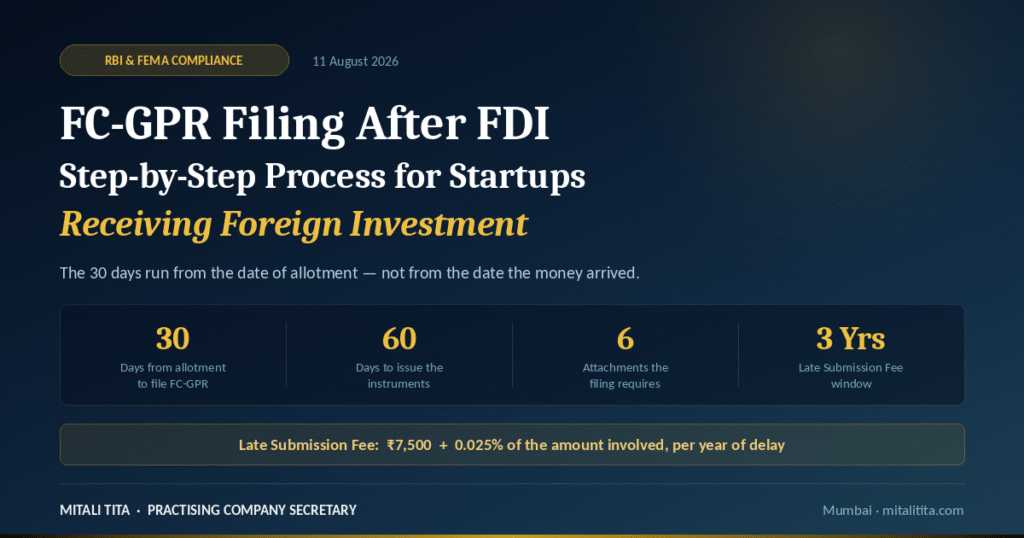
11 August 2026
11 min read
FC-GPR Filing After FDI:
Step-by-Step Process for Startups
Receiving Foreign Investment
The 30 days run from the date of allotment, not from the date the money arrived —
the single most misunderstood point in the entire process. Entity Master ·
Business User · six attachments · FIRMS portal submission · Late Submission Fee
of ₹7,500 plus 0.025% per year of delay.
FC-GPR
FIRMS Portal
Single Master Form
FEMA NDI Rules 2019
30 days from allotment
Late Submission Fee
📌 Quick Answer
FC-GPR filing is the report an Indian company must submit to the Reserve Bank of India
within 30 days of allotting shares or other equity instruments to a foreign
investor, made online through the FIRMS portal and routed for
verification through the company’s authorised dealer bank. The clock starts on the
date of allotment, not the date the remittance was credited. A separate
rule requires instruments to be issued within 60 days of receipt of
consideration, failing which the money must be refunded within 15 days. Missing
the deadline does not invalidate the allotment, but it creates a FEMA default that must
be regularised through a Late Submission Fee of ₹7,500 plus 0.025% of the amount
involved per year of delay — or, past three years, through compounding, where
the penalty can extend to three times the amount involved.
FC-GPR filing is the report an Indian company must submit to the Reserve Bank of India
within 30 days of allotting shares or other equity instruments to a foreign investor,
made online through the FIRMS portal and routed for verification through the company’s
authorised dealer bank. The 30 days run from the date of allotment, not from the
date the money arrived, which is the single most misunderstood point in the
entire process.
For a startup closing its first round with an overseas investor, this is the compliance
step that most often gets discovered late. The Companies Act side of the round usually
goes smoothly, because founders and their advisers are watching it. The exchange control
layer is quietly assumed to be the bank’s responsibility, and it is not. Missing the
FC-GPR filing deadline does not invalidate the allotment, but it creates a FEMA default
that must be regularised through a Late Submission Fee or, past three years, through
compounding. This guide sets out the whole
FC-GPR FDI reporting process
in the order it actually happens.
30
Days from the date of allotment to file FC-GPR on the FIRMS portal
60
Days from receipt of consideration to issue the instruments — else refund in 15 days
6
Attachments required, every one of which should exist before the allotment
3 Yrs
The Late Submission Fee window — after that, compounding is the only route
What Is FC-GPR Filing and When Is It Required?
FC-GPR stands for Foreign Currency Gross Provisional Return. An FC-GPR
filing is required whenever an Indian company issues equity instruments to a person
resident outside India under the foreign direct investment route, and the obligation
sits with the Indian investee company — not with the investor and not
with the bank.
Equity instruments for this purpose are wider than founders expect. They cover equity
shares, compulsorily convertible preference shares, compulsorily convertible debentures
and share warrants. A round structured as
CCPS, which is how most
institutional rounds in India are papered, triggers the same reporting obligation as a
plain equity issue. What is not covered is any instrument that is optionally
convertible or redeemable, because that is treated as debt under the exchange control
framework and follows the external commercial borrowing route instead.
👤
ESOP exercise
A foreign employee exercising stock options
An allotment to a non-resident, and it needs reporting like any other issue.
📄
Rights issue
Taken up by an existing overseas shareholder
Familiar shareholder, same obligation — the instrument is still issued to a non-resident.
🏢
Parent funding
A WOS receiving further capital from its overseas parent
Every tranche needs reporting, however routine it feels internally.
🚫
Not FC-GPR
Optionally convertible or redeemable instruments
Treated as debt under exchange control and routed through ECB instead.
When Does the 30-Day Clock Actually Start?
On the date of allotment. The FC-GPR filing clock starts when the board passes the
allotment resolution and the instruments are issued — not when the
foreign remittance is credited to the company’s account.
This matters because the two dates are rarely the same. Subscription money often sits in
a share application account for weeks while conditions precedent are cleared. A founder
who counts 30 days from the wire transfer will either panic early or, more commonly,
assume the window has already closed and stop thinking about it.
A second and independent deadline runs alongside. Under the FEMA Non-Debt
Instruments Rules, 2019, equity instruments must be issued within 60 days of
receipt of the consideration, and if they are not, the money must be refunded to the
investor within 15 days. So the sequence is: funds arrive, allot within 60 days, then
report within 30 days of that allotment. Where different investors are allotted on
different dates, each allotment carries its own separate window.
| Event | Clock | What Must Happen |
|---|---|---|
| Consideration received | Day 0 for the NDI clock | FIRC issued by the authorised dealer bank; money may sit in the share application account |
| Issue of instruments | Within 60 days | Board allots the equity instruments under the FEMA Non-Debt Instruments Rules, 2019 |
| Failure to issue in time | Refund within 15 days | The consideration must be returned to the investor |
| Date of allotment | Day 0 for FC-GPR | The 30-day reporting window begins here — diarise it in the minutes |
| FC-GPR filing | Within 30 days | Submitted on the FIRMS portal and forwarded by the authorised dealer bank |
📌 Note: The separate Advance Reporting Form was
discontinued when the Single Master Form regime took effect, and the inward remittance
details it used to capture now sit inside FC-GPR itself. Older checklists still list it
as a first step, which sends founders looking for a form that no longer exists. What
does remain separate is the one-time Entity Master registration.
What Documents Do You Need Before You Start?
An FC-GPR filing needs six attachments, and every one of them should
exist before the allotment rather than after it. The FIRMS portal does not save partial
drafts reliably, so assembling the pack first is not merely good practice.
- FIRC — the Foreign Inward Remittance Certificate issued by the authorised dealer bank, evidencing receipt of the funds from outside India
- KYC report on the investor — issued by the remitting bank and shared with the Indian company’s authorised dealer bank
- Valuation certificate — certifying fair value under Rule 21 of the FEMA Non-Debt Instruments Rules, 2019, from a Chartered Accountant, a SEBI-registered Category I merchant banker or a practising Cost Accountant
- Company Secretary certificate — in the format prescribed in the Single Master Form, confirming that the issue complies with the Companies Act 2013 and the FDI policy
- Board resolution — approving the allotment, with the list of allottees and the instruments issued to each
- Declaration and, where relevant, government approval — signed by the authorised representative, together with any approval required where the sector is on the government route or the investor is from a country sharing a land border with India
Get the valuation certificate
dated on or before the allotment date. A certificate dated afterwards is the most common
trigger for a query from the bank, because it suggests the price was fixed without
reference to fair value. The issue price must not fall below the certified fair value;
pricing below it is a FEMA defect in its own right and cannot be cured by the
reporting.
How Do You Complete an FC-GPR Filing on the FIRMS Portal, Step by Step?
Eight steps, of which the first two are one-time registrations that should be completed
before the round closes rather than during it. Companies attempting registration
and reporting in the same 30-day window almost always run out of time.
1
Register the company as an entity on FIRMS
The Entity Master registration captures the company’s identity, its authorised dealer bank and its existing foreign investment position. This is a one-time step and it must be approved before any transaction can be reported. Our EMF and SMF reporting service handles this at the point of incorporation for foreign-owned subsidiaries.
2
Create and get approval for a Business User
A separate Business User login is required to file transaction forms. The authorised dealer bank approves this registration, and approval commonly takes several working days. Register the Business User well ahead of any anticipated allotment.
3
Pass the allotment resolution and fix Day Zero
The board or its committee allots the instruments and records the date. Confirm on the same day that the FIRC has been received and the funds credited. Diarise the reporting deadline as 30 days from this date immediately, in the minutes themselves if possible.
4
Assemble and check the attachment pack
Place all six documents side by side and reconcile the numbers across them. The amount on the FIRC, the consideration in the board resolution, the fair value in the valuation certificate and the figures you will enter on the portal must agree exactly. Mismatches of even a rupee generate queries.
5
Complete the common investment details
Enter the investee company details, the investor name and country, the nature of the investment and the sector with its national industrial classification code. Sector classification determines whether the automatic route applies and whether any cap has been breached, so it deserves more thought than it usually gets.
6
Enter the issue details and shareholding pattern
Record the date of allotment, the type and number of instruments, the face value, premium and total consideration, along with the pre-issue and post-issue shareholding pattern split between residents and non-residents. The post-issue pattern must tie to the cap table.
7
Upload the attachments, sign and submit
Upload each document in the prescribed format, run the portal validation, apply the digital signature of the authorised representative and submit the form to the authorised dealer bank. Save the acknowledgement and a PDF of the submitted form before closing the session.
8
Track the bank query and confirm approval
The authorised dealer bank reviews the filing and may raise queries, which should be answered within a few working days to stay inside the window. Once the bank is satisfied it forwards the filing and the status on the portal moves to approved. Keep that confirmation in the corporate records; it is the document an investor will ask for at the next round.
⚠️ Press Note 3 of 2020 — Check Before the Money Moves
Any investment from an entity in a country sharing a land border with India, or
where the beneficial owner is situated in such a country, requires prior
government approval regardless of sector or amount.
Filing FC-GPR without that approval reports a transaction that should not have
happened, which is a substantive contravention rather than a reporting
one. Check the beneficial ownership chain before the money moves, not after.
What Happens If You Miss the 30-Day Deadline?
The FC-GPR filing is still made, but a Late Submission Fee becomes
payable. For FC-GPR the fee is ₹7,500 plus 0.025% of the amount involved
multiplied by the delay expressed in years, where the number of months of delay
is rounded up and divided by twelve.
| Worked Example | Figure |
|---|---|
| Amount allotted on 15 January 2026 | ₹20 crore |
| Reporting due by | 14 February 2026 |
| Actually filed on | 14 August 2026 — six months late |
| Delay component: 0.025% of ₹20 crore | ₹50,000 |
| Multiplied by 6 ÷ 12 (delay in years) | ₹25,000 |
| Plus the flat component | ₹7,500 |
| Total Late Submission Fee | ₹32,500 |
⚠️ A widely repeated error: a number of published guides compute the
delay component per month rather than per year, and arrive at a figure roughly
twelve times too high. The multiplier is the delay expressed in years — months rounded
up, divided by twelve.
❌ Past Three Years, the Cheap Route Closes
The Late Submission Fee route stays open for three years from the due
date. Past that point it is no longer available and the default must be
regularised through compounding under FEMA, where the penalty can
extend to three times the amount involved. That is when a ₹32,500
problem becomes a genuinely expensive one.
Where a company discovers historic unreported allotments, the sensible order is to
quantify the exposure first, then decide between the Late Submission Fee route and a
compounding application.
Voluntary disclosure before an investigation begins is treated considerably more
favourably than disclosure prompted by a diligence exercise or a regulator’s
query.
Why Do FC-GPR Filings Get Rejected or Queried?
Almost always because of internal inconsistency inside the FC-GPR filing itself, rather
than any substantive problem with the investment. The authorised dealer bank reconciles
the form against the attachments, and any figure that does not match generates a query.
| Recurring Cause | Type | How It Is Avoided |
|---|---|---|
| Valuation certificate dated after the allotment | Most common | Obtain the certificate on or before the allotment date |
| FIRC amount differs from the consideration in the board resolution | Mismatch | Reconcile every figure across all six attachments before submitting |
| Incorrect industrial classification code for the sector | Data | Confirm the code and the applicable route before entering it |
| Shareholding pattern does not reconcile to the cap table | Mismatch | Tie the post-issue pattern to the cap table line by line |
| Instruments misclassified as equity when optionally convertible | Substantive | Classify at term-sheet stage — optionally convertible instruments follow the ECB route |
None of these are difficult problems. They are all consequences of preparing the filing
after the fact from documents assembled by different people at different times. Each
query costs days, and days come out of a 30-day budget. A filing submitted on
day 28 with one query attached will miss the deadline. Submitting by day ten
leaves room for a round of clarification and still lands inside the window.
What Other FEMA Filings Follow a Foreign Investment Round?
Two, and both are missed as routinely as the FC-GPR filing itself.
| Filing | Deadline | When It Applies |
|---|---|---|
| FC-GPR | 30 days from allotment | Fresh issue of equity instruments to a person resident outside India |
| FLA Return | 15 July every year | Any company that has received foreign investment — in that year or in any earlier one |
| Form FC-TRS | 60 days from transfer | Shares moving between a resident and a non-resident by transfer rather than fresh issue — secondary sales, founder transfers to an overseas holding entity, investor exits |
Our FLA return compliance
service files the annual return provisionally where the audit is not complete by the
deadline, which is permitted and far better than filing late.
Companies that will receive foreign capital repeatedly should treat all of this as a
calendar rather than a series of events. For a
foreign
subsidiary or a startup on a funding path, a quarterly review of the FIRMS portal
position against the cap table catches errors while they still cost nothing.
How Has India’s FDI Reporting Framework Changed Since Before 1991?
Before 1991 the framework was designed to keep foreign capital out rather than to record
it. The Foreign Exchange Regulation Act, 1973 capped foreign shareholding in most Indian
companies at 40% and required approval for almost everything, which is why several
well-known multinationals chose to leave India in the late 1970s rather than dilute.
Reporting was not a meaningful discipline because the transactions themselves were rare
and individually negotiated with the
Reserve Bank of India.
Liberalisation reversed the presumption. The New Industrial Policy of 1991 introduced an
automatic route for foreign investment in specified sectors and created the Foreign
Investment Promotion Board for everything else. The Foreign Exchange Management
Act, 1999 then replaced the prohibitionist statute with a regulatory one,
recasting violations as civil contraventions to be compounded rather than criminal
offences. The Foreign Investment Promotion Board itself was abolished in 2017, leaving
the automatic route and sectoral ministries to handle approvals.
Reporting was consolidated much more recently. Until 2018 a company reported foreign
investment through nine separate returns filed in different places, and
it was entirely possible to comply with one and miss another. The Single Master Form on
the FIRMS portal brought them into one system, and the Advance Reporting Form disappeared
into FC-GPR at that point. The FEMA Non-Debt Instruments Rules, 2019 then moved the
substantive rules on equity instruments and pricing into a single instrument, and the
Late Submission Fee framework introduced in 2022 gave companies a way to regularise
routine delays without a full compounding application.
The direction of travel is towards a single reconciled record of every rupee of foreign
investment in every Indian company. That is convenient when the record is accurate and
unforgiving when it is not, which is why ongoing
RBI and FEMA compliance has
moved from a periodic exercise to a continuous one.
Why Startups and Foreign-Owned Subsidiaries Choose Mitali Tita
🗝️
Registrations Done Before the Round Closes
Entity Master and Business User registrations are completed ahead of the allotment, so the whole 30-day window is available for the filing itself rather than for onboarding.
📜
The CS Certificate the Form Requires
The Company Secretary certificate prescribed in the Single Master Form is issued in-house, in the required format, confirming compliance with the Companies Act 2013 and the FDI policy.
🏦
Coordination with Your AD Bank
Queries from the authorised dealer bank are answered directly and quickly, which is what keeps a filing inside the window once it has been submitted.
🗓️
The Filings That Follow
The annual FLA return and Form FC-TRS on any secondary transfer are tracked as a calendar, not remembered as events.
🔍
Historic Positions Checked and Regularised
If you have already allotted shares to a foreign investor and are not certain whether the reporting was done, that is worth checking now rather than at your next diligence — exposure is quantified first, then the Late Submission Fee or compounding route is chosen.
MT
Mitali Tita
Practising Company Secretary · Mumbai
Mitali Tita is a qualified, practising Company Secretary based in Mumbai, advising
startups, SMEs, NBFCs, listed companies and foreign investors entering India. Her
practice covers the Companies Act 2013, FEMA and RBI reporting, SEBI LODR, IBC and
MCA regulations, alongside company incorporation, secretarial audit and trademark
work. Every article published on mitalitita.com is reviewed against the current
provisions of Indian corporate and exchange control law before publication. Office:
Suite No.102, L1, Ashok Premises, Nicholas Road, Andheri (East), Mumbai 400069 ·
+91 98190 00640 / +91 98190 00445 / +91 98218 32683.
FC-GPR Filing After FDI — Your Questions Answered
Direct answers to what founders ask most — who files, when the clock starts, how the
Late Submission Fee is worked out, whether the Advance Reporting Form still exists, who
may certify the valuation, and how ESOP exercises by foreign employees are treated.
FC-GPR stands for Foreign Currency Gross Provisional Return. Every Indian company
that issues equity instruments to a person resident outside India under the
foreign direct investment route must file it with the Reserve Bank of India
through the FIRMS portal. Equity instruments include equity shares, compulsorily
convertible preference shares, compulsorily convertible debentures and share
warrants. The obligation sits with the Indian investee company,
not with the foreign investor and not with the authorised dealer bank, although
the filing is routed through that bank for verification.
From allotment. The 30 days run from the date on which the board
passes the allotment resolution and the equity instruments are actually issued,
not from the date the foreign remittance lands in the bank account. This
distinction matters because subscription money frequently arrives weeks before
allotment. A separate rule under the FEMA Non-Debt Instruments Rules requires the
instruments to be issued within 60 days of receipt of consideration, failing which
the money must be refunded to the investor within 15 days.
The Late Submission Fee for FC-GPR is ₹7,500 plus 0.025% of the amount
involved multiplied by the period of delay expressed in years, where the
delay in months is rounded up and divided by twelve. On a ₹20 crore allotment
reported six months late, that works out to ₹7,500 plus ₹25,000, or ₹32,500. The
Late Submission Fee route is available for up to three years from the due date.
Beyond that the default must be regularised through
compounding.
No. The Advance Reporting Form was discontinued when the Single
Master Form regime came into effect on the FIRMS portal, and the inward remittance
details it used to capture are now reported within FC-GPR itself. Many older
articles and checklists still list it as a separate step, which causes founders to
look for a form that no longer exists. What does remain separate is the one-time
Entity Master registration, which must be completed before any Single Master Form
filing can be made.
Under Rule 21 of the FEMA Non-Debt Instruments Rules, 2019, the fair value of
equity instruments issued to a non-resident must be certified by a Chartered
Accountant, a SEBI-registered Category I merchant banker, or a practising Cost
Accountant, using an internationally accepted pricing methodology applied on an
arm’s length basis. The issue price must not be lower than that fair value. Obtain
the certificate before
the allotment rather than after it, because a certificate dated later than the
allotment invites a query from the authorised dealer bank.
Yes, at the point of allotment. When shares are actually issued to
a person resident outside India on exercise of employee stock options, that
allotment is an issue of equity instruments to a non-resident and the same 30-day
reporting obligation applies. Companies with foreign employees on an ESOP plan
often treat exercises as a payroll event and miss the FEMA layer entirely. Each
allotment date carries its own separate 30-day window, so batching exercises
deliberately reduces the number of filings.
You May Also Find Useful
FDI Reporting
FC-GPR FDI Reporting — Filing, Documents and Bank Coordination
Read Guide →
FIRMS Portal
EMF & SMF Reporting — Entity Master and Single Master Form Registration
Read Guide →
Annual FEMA
FLA Return Compliance — The 15 July Annual Filing for FDI Companies
Read Guide →
Instruments
Issuance of CCPS — Structuring and Post-Allotment Compliance
Read Guide →
Valuation
Valuation Services — Fair Value Certification under Rule 21
Read Guide →
Regularisation
Compounding of Offence under FEMA — When the LSF Route Has Closed
Need Professional Help with FC-GPR Filing?
Entity Master & Business User registration · CS certificate for the Single Master Form ·
AD bank coordination · FLA and FC-TRS filings · historic positions checked and regularised.
📞 +91 98190 00640 · +91 98190 00445 · +91 98218 32683 · 📧 info@mitalitita.com
📋 Check Your FDI Reporting Position
View Our FC-GPR Service →
This article is for general information and is not legal advice. Reporting timelines,
Late Submission Fee rates, portal procedures and sectoral conditions under the FDI policy
are subject to change through RBI circulars, Press Notes and amendments to the FEMA
Non-Debt Instruments Rules, 2019. Please consult a qualified Company Secretary for advice
specific to your company’s circumstances and confirm the current position with the Reserve
Bank of India and your authorised dealer bank before acting. Mitali Tita | Practising
Company Secretary | Suite No.102, L1, Ashok Premises, Nicholas Road, Andheri (East),
Mumbai 400069.