10 June 2026
10 min read
SBO Compliance Under
Section 90: Who Must File
and How
BEN-1 · BEN-2 · BEN-3 · BEN-4 · 8 triggering events · Full penalty matrix ·
Annual review process · Complex ownership chains — and why SBO compliance never stops at the first filing.
SBO Compliance
Section 90
BEN-1 / BEN-2
Significant Beneficial Owner
Company Secretary
MCA Filing
📌 Quick Answer
Section 90 of the Companies Act 2013 requires every company to identify its
Significant Beneficial Owners (SBOs) — natural individuals with
≥10% beneficial interest through direct or indirect shareholding — and report
them via Forms BEN-1, BEN-2, BEN-3, and BEN-4 within 30 days
of any triggering event. SBO compliance is not a one-time activity: it restarts
with every allotment, share transfer, restructuring, or change in the upstream ownership of a
member entity. Non-compliance carries penalties of up to ₹50 lakh per company
and ₹10 lakh per officer, with additional risks under Section 447 for
fraudulent declarations.
Most companies treat Significant Beneficial Owner (SBO) compliance under Section 90 as a
one-time activity. The ISIN is obtained, the first round of BEN declarations is processed,
BEN-2 is filed with the ROC, and the task is considered complete. This is a
fundamental misreading of the obligation. Section 90 is a living compliance
requirement — it must be reassessed every time the ownership structure of the company or its
member entities changes, and fresh filings must be made within 30 days of any triggering event.
The gap between initial SBO setup and ongoing maintenance is the single most common
observation in secretarial audits under Section 204. A company may have diligently filed
BEN-2 three years ago — but if that corporate member was subsequently merged, or a new
individual became a controlling shareholder above, every day without an updated BEN-1 and
BEN-2 is a day of continuing default. This guide focuses on the
ongoing compliance dimension of Section 90.
What is SBO Compliance Under Section 90 — A Concise Recap
Section 90 of the Companies Act, 2013 requires every company to identify the
Significant Beneficial Owners (SBOs) of its shares — the ultimate natural
individuals who hold 10% or more of beneficial interest (through shares, voting rights, or
dividend entitlement) directly or indirectly through entity layers — and maintain a register
of such SBOs while reporting them to the ROC.
Sec. 90
Companies Act 2013 — governing provision
10%
Threshold — beneficial interest that triggers SBO status
4 Forms
BEN-1, BEN-2, BEN-3, BEN-4 — the complete SBO toolkit
30 Days
Deadline for BEN-1 and BEN-2 from any triggering event
The 4 SBO Forms at a Glance
- BEN-4: Company to potential SBO — formal notice requesting SBO identification
- BEN-1: SBO to company — declaration of significant beneficial ownership
- BEN-2: Company to ROC — return of SBO information, filed within 30 days of receiving BEN-1
- BEN-3: Internal SBO register maintained at the company’s registered office
Legal Reference: Section 90, Companies Act, 2013. Companies (Significant Beneficial Owners) Rules, 2018 (13 June 2018) as amended by Companies (Significant Beneficial Owners) Amendment Rules, 2019 (1 July 2019). MCA has additionally issued clarificatory FAQs on specific applicability questions.
Why SBO Compliance is Ongoing — Not a One-Time Activity
Section 90(4) requires every individual who is an SBO to file a declaration
whenever there is a change in the significant beneficial ownership from the
particulars last declared. Section 90(5) requires the company to file a return with the ROC
whenever it receives a declaration. These provisions make SBO compliance
continuous — not periodic. Three categories of events make the obligation recurring:
🏢
Changes at the Company Level
New share issuances (allotments, rights, bonus), share transfers, buy-backs — any can shift the percentage of beneficial interest across the 10% threshold in either direction.
🔗
Changes Within Member Entities
If the holding company, trust, HUF, or LLP that is the company’s member undergoes its own ownership change, the ultimate individual behind it changes — even if the entry in the register appears unchanged.
👤
Changes at the Individual Level
Death of the SBO, legal heir inheriting the beneficial interest, partition of HUF, variation of a trust deed — all change who the SBO is without any visible change in the company’s own share register.
⚠ The Hidden Risk: The most dangerous SBO compliance gap is where the company’s own register of members has NOT changed — so the CS sees no reason to update BEN records — but the ultimate individual behind a member entity HAS changed. There is no automatic notification system. The company’s only protection is an annual structured SBO review that goes one or two levels above the register of members.
8 Events That Trigger a Fresh SBO Filing — Complete Reference Table
Every CS professional managing SBO compliance should keep this table close. It maps every
common corporate event to its SBO consequence, the forms required, and the specific error
most often made:
| Triggering Event | SBO Impact | Forms Required | Deadline | Most Common Error |
|---|---|---|---|---|
| New investor subscribes through a corporate entity | New potential SBO arises — ultimate individual behind the entity must be identified | BEN-4 → BEN-1 → BEN-2 → Update BEN-3 | 30 days from allotment | Filing FC-GPR without triggering the SBO exercise simultaneously |
| Entity member transfers shares to another entity or individual | Old SBO may cease; new SBO may arise if transferee is an entity | Updated BEN-1 → Updated BEN-2 → Update BEN-3 | 30 days from transfer date | Registering the transfer without updating BEN-3 or filing BEN-2 to remove old SBO |
| Promoter transfers shares to a new holding company | New SBO filing arises — promoter is now an SBO through the entity layer | BEN-4 → BEN-1 → BEN-2 → BEN-3 update | 30 days from transfer date | Treating this as a routine SH-4 without recognising the new SBO obligation created by the entity layer |
| Rights issue or bonus issue changes percentage holdings | Member entity previously below 10% may cross threshold post-issue | Post-issue SBO recalculation → BEN-4 → BEN-1 → BEN-2 amendments | 30 days from allotment | Filing rights/bonus ROC forms without a post-issue SBO recalculation |
| Change in ownership of the member entity (new shareholders above) | Ultimate individual changes even though the company’s member register appears unchanged | BEN-4 → fresh BEN-1 from new ultimate individual → Updated BEN-2 | 30 days from date change becomes known to company | Not monitoring upstream changes — company’s own member is unchanged so the SBO shift goes undetected |
| Death of an SBO — transmission of beneficial interest | Existing SBO ceases; legal heir(s) crossing 10% become new SBOs | Updated BEN-3 (cessation) → BEN-4 → BEN-1 from heir → BEN-2 | 30 days from heir establishing their interest | Not updating BEN-3 and BEN-2 on SBO death — deceased individual remains on record indefinitely |
| Merger / amalgamation of the member holding company | Completely fresh SBO analysis required for the resulting merged entity | Full SBO review → BEN-4 → BEN-1 → BEN-2 → BEN-3 updated | 30 days from effective merger date | Assuming existing SBO filings remain valid when the member entity itself has changed through restructuring |
| ESOP exercises shift total share count | Exercises dilute existing entity members’ percentages — crossings may occur in either direction | Post-exercise recalculation → BEN-4/BEN-1 for newly triggered members → Updated BEN-2/BEN-3 | 30 days from exercise date | Treating ESOP compliance as a separate exercise without reassessing SBO thresholds across all entity members |
✅ CS Action Rule: After every corporate event that touches shares — allotment, transfer, rights issue, bonus, restructuring, or ESOP exercise — the first question must be: has any entity member’s percentage holding crossed the 10% SBO threshold (up or down)? Build this check into every share-related board resolution workflow.
How to Build an Annual SBO Review Into Your Compliance Calendar
Beyond event-triggered filings, a structured annual SBO review provides a safety net that
catches changes the event-triggered process might miss. Here is the 6-step process every
CS managing SBO compliance should follow:
1
Pull the Register of Members — Identify All Non-Individual Members
Every entity in the register — Indian holding companies, foreign entities, trusts, HUFs, LLPs — must be on the review list. Cross-reference against last year’s BEN-3 to identify any new entity members that have never been through the BEN process.
2
Request Updated Shareholding Information from Each Entity Member
Write formally to each entity member asking them to confirm: (a) whether their ownership structure has changed since the last BEN-1 was filed; (b) whether the ultimate individual beneficial owner has changed; and (c) whether any beneficial interest percentage has crossed the 10% threshold.
3
Recompute Proportionate Indirect Beneficial Interests
For each entity member, multiply the company’s shareholding percentage by the entity’s own ownership structure down to the ultimate natural person. Compare current computed percentages against last filed BEN-1 figures. Flag any changes for further action.
4
Issue Fresh BEN-4 Notices Where Changes Are Detected
A formal BEN-4 notice creates a legal paper trail of the company’s due diligence effort. For entities that did not respond, BEN-4 creates the basis for an NCLT application if non-response continues. Issuing BEN-4 proactively demonstrates compliance — waiting passively does not.
5
Process Updated BEN-1 Filings and Update BEN-3
Collect fresh BEN-1 declarations from any SBO whose details have changed. Update the BEN-3 Register of SBOs within 30 days of each BEN-1 received. Clearly flag cessation of old SBOs and commencement of new ones with effective dates.
6
File Updated BEN-2 with the ROC for Every Change
File within 30 days of receiving each updated BEN-1. The BEN-2 form must clearly indicate whether this is an initial filing, an amendment, or a cessation. Ensure the annual SBO review outputs are aligned with your annual filings calendar so BEN-2 updates are not processed in isolation from the broader compliance cycle.
How to Read a Complex Ownership Chain — Step-by-Step Example
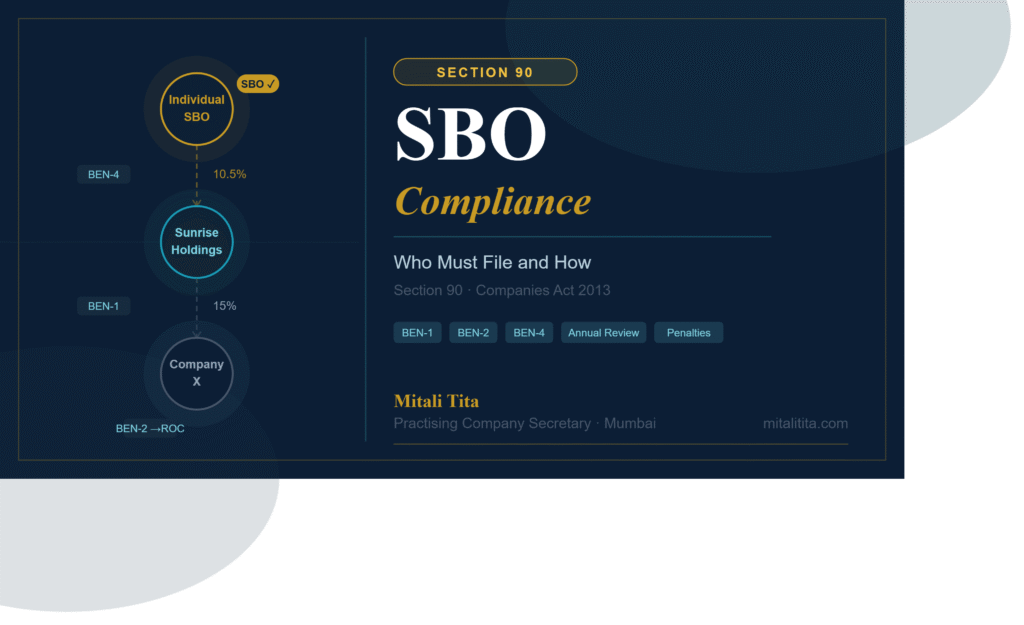
Consider a private company (Company X) with this Register of Members entry:
“Sunrise Holdings Pvt Ltd — 15% equity shares.”
To identify the SBO, the CS must trace the chain step by step.
Initial SBO Identification
- Step 1: Who owns Sunrise Holdings Pvt Ltd? — Individual A: 70%, Individual B: 30%
- Step 2: Compute each individual’s indirect interest in Company X. Individual A: 70% × 15% = 10.5%. Individual B: 30% × 15% = 4.5%
- Step 3: Apply the 10% threshold. Individual A (10.5%) ≥ 10% → Individual A is an SBO. Individual B (4.5%) < 10% → not an SBO
- Step 4: Issue BEN-4 to Sunrise Holdings Pvt Ltd, identifying Individual A as the person believed to be the SBO and requesting Individual A to file BEN-1
- Step 5: Individual A files BEN-1 with Company X disclosing the chain: Individual A → Sunrise Holdings Pvt Ltd → Company X
- Step 6: Company X files BEN-2 with the ROC within 30 days of receiving BEN-1, and updates BEN-3 to record Individual A as SBO with 10.5% indirect beneficial interest
The Change Event — Why Records Go Stale
Now consider a change event: Individual A sells 25% of their shares in Sunrise Holdings to
Individual C. After the transaction:
- Individual A: 45% × 15% = 6.75% — below 10%, ceases to be SBO
- Individual C: 25% × 15% = 3.75% — below 10%, not an SBO
- Individual B: 30% × 15% = 4.5% — unchanged, not an SBO
Company X now has no SBO through Sunrise Holdings. An updated BEN-1 from
Individual A (marking cessation), an updated BEN-2 to ROC, and an updated BEN-3 must all
be processed — triggered by a change in Sunrise Holdings’ shareholding that is
completely invisible in Company X’s own register of members. This is precisely
why annual outreach to entity members is essential for SBO compliance maintenance.
The Complete SBO Penalty Matrix — Every Default and Its Consequence
Section 90 carries some of the highest non-fraud penalty amounts in the Companies Act for a
procedural compliance default. The table below covers every category of SBO default, who
bears personal liability, and what the financial and legal consequences are.
⚠️ Director Personal Liability Warning — Section 90
Officers “in default” under Section 90 include every director who was aware of
the non-compliance or should reasonably have been aware. In a company with a
non-compliant BEN-3 register, all directors — not just the CS — face personal fines of
up to ₹10,00,000 each. SBO compliance is a board-level responsibility,
not merely a secretarial function.
| Nature of Default | Person Liable | Minimum Penalty | Maximum Penalty | Additional Consequences |
|---|---|---|---|---|
| SBO fails to file BEN-1 within 30 days of becoming an SBO | The individual SBO personally | ₹50,000 | ₹5,00,000 | ₹1,000 per day for continuing default. Shares may be restricted by NCLT on company application. |
| SBO fails to update BEN-1 when beneficial interest changes | The individual SBO personally | ₹50,000 | ₹5,00,000 | ₹1,000 per day for continuing default. May be treated as wilful non-disclosure. |
| Company fails to maintain Form BEN-3 Register of SBOs | Company + every officer in default | Company: ₹10,00,000 Each officer: ₹1,00,000 |
Company: ₹50,00,000 Each officer: ₹10,00,000 |
BEN-3 non-maintenance is a mandatory adverse observation in Secretarial Audit reports under Section 204. MCA may initiate inquiry. |
| Company fails to file BEN-2 with ROC within 30 days of receiving BEN-1 | Company + every officer in default | Company: ₹10,00,000 Each officer: ₹1,00,000 |
Company: ₹50,00,000 Each officer: ₹10,00,000 |
Delayed BEN-2 creates a traceable gap in MCA records. Companies may need to compound the default before MCA processes other approvals. |
| Company fails to issue BEN-4 notice to a potential SBO | Company + officers in default | Company: ₹10,00,000 Each officer: ₹1,00,000 |
Company: ₹50,00,000 Each officer: ₹10,00,000 |
Failure to issue BEN-4 demonstrates lack of due diligence in identifying SBOs — aggravating the penalty position in MCA proceedings. |
| Non-compliance with NCLT order on restricted shares | Company + officers in default | As per NCLT order / Contempt of Court | Non-compliance with NCLT orders is Contempt of Court — a separate legal proceeding with potential imprisonment for directors. | |
| False or fraudulent information in Form BEN-1 declaration | The individual SBO who filed the false BEN-1 | Section 447 — imprisonment up to 10 years + unlimited fine | Section 447 (fraud) is a criminal provision. Applies where beneficial ownership is deliberately concealed — the most serious SBO-related penalty. | |
How SBO Compliance Links to Annual MCA Filings and Secretarial Audit
SBO compliance is embedded within the broader annual compliance framework and is specifically examined in secretarial audit.
Annual Return (MGT-7 / MGT-7A)
The Annual Return filed with the ROC includes details of the Register of Members and
significant changes in shareholding. A company whose register contains entity members must
have corresponding BEN records. Secretarial auditors cross-reference the Annual Return
against BEN filings — gaps create adverse audit observations.
Financial Statements (AOC-4)
The Notes to Accounts often disclose related party transactions with holding companies or
other entity members. If an entity member appearing in related party disclosures has not
been put through the BEN process, the inconsistency between the financial statement disclosure
and the SBO register is flagged during audit. See our
Annual Filings of Company
service for integrated compliance tracking.
Secretarial Audit (Form MR-3)
Under Section 204, companies meeting the prescribed size threshold must obtain a secretarial
audit. SBO compliance is a mandatory area of examination in every secretarial audit.
The secretarial auditor specifically checks: (a) whether BEN-3 is maintained and current;
(b) whether BEN-2 has been filed for every non-individual member; (c) whether filing dates
are within the 30-day deadline; and (d) whether any events during the year should have
triggered updated BEN filings. Our
Secretarial Audit engagements always
include a dedicated SBO compliance review.
XBRL Filing
Companies required to file XBRL financial statements must tag their Register of Members and
related party details accurately. SBO information in BEN records should be consistent with
related party and group company disclosures in XBRL-tagged financials. Inconsistencies between
BEN records and XBRL Filing
data can trigger MCA scrutiny.
Rights Issues, Bonus Issues, and Their SBO Implications
Corporate actions that change total share capital — rights issues, bonus issues, private
placements — can silently push entity members across the 10% SBO threshold in either direction.
This is the most frequently missed SBO trigger in growing companies.
📈
Rights Issue — Subscribed by Entity Member
If a corporate member subscribes to a rights issue, their percentage increases. A member previously below 10% may cross the threshold — triggering first-time SBO compliance.
📉
Rights Issue — Not Subscribed by Entity Member
If a corporate member does not subscribe (or subscribes less), other members’ percentages increase. Members holding just below 10% may now cross the threshold.
🎁
Bonus Issue — Proportionate for All
A bonus issue does not change percentage holdings — all existing members receive shares in the same proportion. Percentage-based SBO thresholds are unaffected by bonus issues alone.
🆕
Private Placement to New Entity Investor
A new entity investor crossing 10% requires immediate SBO analysis — even if existing entity members’ percentages are now diluted below 10%, triggering cessation of existing SBOs simultaneously.
💡 CS Practice Note: Every Rights Issue compliance process handled by our CS team includes a post-issue SBO recalculation as a standard step — ensuring no threshold change goes unaddressed at the time of allotment.
SBO Compliance Gaps Most Commonly Found in Secretarial Audits
📋
BEN-3 Not Formally Constituted
Companies maintain BEN-1 copies but have not formally constituted a BEN-3 register. The register is a statutory document — its absence is a separate default from missing BEN-1 or BEN-2 filings.
⏰
BEN-2 Filed After 30-Day Window
BEN-1 collected but BEN-2 delayed. Even a belated BEN-2 is a compoundable default under Section 441 — the company must approach MCA for compounding before the filing is regularised.
🔄
BEN Records Not Updated After Share Transfer
A transfer involving an entity member is processed without triggering the SBO review — BEN-3 not updated, BEN-2 not filed to reflect old SBO cessation or new SBO commencement.
📨
BEN-4 Not Issued Proactively
Company waits for SBOs to come forward voluntarily. The company’s independent obligation to issue BEN-4 is separate from the SBO’s obligation to file BEN-1 — waiting is not sufficient.
🌐
Foreign Companies Treated as Auto-Exempt
Some CS professionals incorrectly assume all foreign investors are exempt (like SEBI AIFs). Foreign entities are NOT automatically exempt — only those meeting specific Rule 8 criteria qualify.
📊
No Post-Issue SBO Recalculation
ESOP exercises and rights issues change percentage holdings, but the SBO threshold recalculation is omitted — the company processes the corporate action and ROC forms without a corresponding BEN review.
MT
Mitali Tita
Practising Company Secretary · Mumbai
Mitali Tita is a Practising Company Secretary in Mumbai. She provides SBO compliance
services including BEN-1/2/3/4 processing, annual SBO reviews, event-triggered filings,
and secretarial audits (Form MR-3) that include a dedicated SBO compliance examination.
Her practice spans listed companies, public companies, and private companies with
significant entity memberships — as well as companies preparing for fundraising,
acquisition, or regulatory readiness. Office: Suit No. 102, Ashok Premises, Andheri East, Mumbai 400069.
Advanced SBO Compliance — Your Questions Answered
Direct answers to the advanced SBO compliance questions we hear most often — circular
structures, upstream changes, strike-offs, cessation filings, and share transfer obligations.
A circular holding structure — where Company A holds shares in Company B, and Company B
holds shares in Company A — does not eliminate the SBO obligation. The
ultimate beneficial owner must still be identified as the natural person
who controls or benefits from the arrangement. The circularity requires the company to
identify the natural person who has the power to direct the circular holding structure as a whole.
In practice, regulators treat circular structures with heightened scrutiny as potential
mechanisms to obscure beneficial ownership. The CS should document the entire chain,
identify the controlling individual, and ensure BEN filings accurately reflect the
reality of who ultimately benefits.
Yes — and this is one of the most important ongoing SBO obligations.
Section 90(1) requires every individual who is an SBO to report any change in their
significant beneficial ownership. If an individual becomes an SBO (or ceases to be one)
because the intermediate holding company’s shares change hands, that individual must file
an updated BEN-1 with the company.
The holding company — as the member of record — does not appear to have changed in the
company’s own register; but the ultimate SBO has changed. The company’s
annual SBO outreach to entity members is the primary mechanism for
detecting such upstream changes. Companies can also include a contractual obligation in
shareholders’ agreements requiring any investor entity to notify the company within 30
days of any change in the ownership of the investing entity.
SBO compliance obligations continue until the company is formally dissolved
and its name is struck off the register. When a company applies under Section 248
(fast track strike-off) or undergoes voluntary winding up, it remains a legal entity
until dissolution — and its obligations under Section 90 subsist throughout this period.
During the strike-off process, the CS must ensure BEN records are current and accurate.
After dissolution, SBO records form part of the company’s statutory books
and must be preserved for 8 years, even after the company ceases to exist.
Within 30 days of the date on which their beneficial interest fell below the
10% threshold. The cessation of SBO status is itself a change in SBO particulars
that triggers the update obligation under Section 90(4). The individual must file an
updated BEN-1 specifically declaring that their beneficial interest is now below 10%
and that they are ceasing to be a Significant Beneficial Owner.
The company then files an updated BEN-2 with the ROC reflecting the cessation, and the
BEN-3 register is updated to record the cessation date. Failure to file the cessation
BEN-1 means the individual remains on record as an SBO even though they no
longer meet the threshold — creating a false record and a mandatory adverse
observation in every subsequent secretarial audit.
The Companies Act does not explicitly make SBO pre-compliance a condition for registering
a share transfer. However, the CS should recommend delaying registration
until the transferee entity has provided the necessary SBO documentation — a BEN-4
response or a BEN-1 commitment from the identified SBO. This approach is supported by
the CS’s duty to maintain accurate and current SBO records.
In practice, companies include an SBO compliance representation in their share
transfer forms — requiring entity transferees to identify their ultimate
beneficial owner and commit to filing BEN-1 within 30 days of the transfer being
registered. Failure to obtain this representation means the company accepts the
Transfer of Shares into its
records while knowing that BEN compliance is outstanding — a default that falls on the
company and its officers.
You May Also Find Useful
Secretarial Audit
Secretarial Audit in 2026: Applicability, Process & Why It Protects Your Company
Read Article →
Annual Filings
Annual ROC Filings — AOC-4, MGT-7 and All Company Compliances
Read Guide →
MCA Amnesty
Everything You Need to Know About the MCA Compliance Amnesty Scheme 2026
Read Article →
Share Transfer
Transfer of Shares — Procedure, SH-4, and Compliance Requirements
Read Guide →
Rights Issues
Right Issues — Compliance Process and Post-Issue SBO Recalculation
Read Guide →
XBRL Filing
XBRL Filing of Companies — Tagging Requirements and MCA Submission
Need Ongoing SBO Compliance Support?
SBO compliance is not a one-time exercise. It needs an expert who stays on top of every
triggering event, runs your annual review, and keeps your BEN records audit-ready year-round.
📋 Get SBO Compliance Support
View Our SBO Compliance Service →
This article is for general information and is not legal advice.
SBO thresholds, exemptions, and filing requirements may vary based on your company’s specific
ownership structure, entity type, and applicable rules as amended from time to time.
Please consult a qualified Company Secretary for advice tailored to your business.